
Last year, I built a DDR4 system with an Intel 13500 processor. I was going to create something future-proof, a phrase we use to lie to ourselves so we can sleep at night. But as it turns out, the future arrived approximately three months after I hit the power button for the first time. Suddenly, DDR5 motherboards weren’t just available, they were ubiquitous. The prices dropped sharply. My cutting-edge DDR4 build began to look like painfully yesterday. I found myself spiraling into the “Severance-like panic” of PC subreddits, where enthusiasts discuss clock speeds with the religious fervor of a Victorian occultist.
That was until I stumbled upon a thread on Reddit that perfectly encapsulated the absurdity of my predicament.
DDR4 is still perfectly relevant. If you were building a completely new build you wouldn’t likely spec it out, but it’s more than enough to play everything now. Here’s an analogy from u/minerlj last year that I think summarizes it well:
DDR4 city has a 3600mhz cl16 train system. its trains go 36 miles an hour, and a train arrives at each station every 16 minutes to pick up/drop off passengers. assuming an arbitrary trip length of 36 miles, the average trip length will be 1 hour, meaning if you arrive at the station just in time to catch a train, the maximum trip length is 1 hour and if you are unlucky and arrive at the station and just miss your train, the maximum trip length will be 1 hour and 16 minutes. The average trip length however is 60+8.5 = 68.5 minutes
The neighboring DDR5 city, has a 6000 mhz cl40 train system. its trains go faster: 60 miles an hour. but a train arrives at each station less often: every 40 minutes to pick up/drop off passengers. Assuming an arbitrary trip length of 36 miles, the average trip length will be 36 minutes if you arrive at the station just in time to catch a train, the maximum trip length is 36 minutes. if you arrive at the station and just miss your train, the maximum trip length will be 36 minutes and 40 minutes, or 76 minutes total (1 hour and 16 minutes total – the exact same max trip time as DDR4 city if you just miss your train in that city). The average trip length however is 36+20.5 = 56.5 minutes
So if you had to choose which city to live in, you would probably choose DDR5 city. on average you’ll get where you need to go 17.5% faster. —- end of analogy
So, here are the things that I think the analogy is missing, The amount of data that we’re talking about it is variable based on what you’re doing, and we’re not talking about is more like milliseconds not minutes. Can you tell the difference between 56ms and 68ms? probably not. So what does it practically mean? Well I found a YT Video that compares some recent games between the two memories. Check it out: https://youtu.be/YESz_XA2kKc?si=AfLmn4FAwiH-LOLp
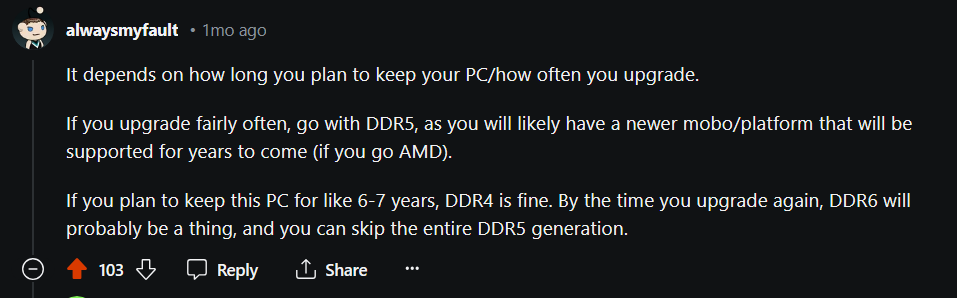
This brings us to the Modern Theory of Perceptual Latency (MTPL). In the high-stakes world of creation, we obsess over the delta between 56ms and 68ms. But if you stare too long at the screen, as I have, you realize that these milliseconds are just facades.
Can the human eye detect the difference between a DDR4-3600 fetch and a DDR5-6000 transfer while you’re actually doing something? Most likely not. We are grasping at shadows of folds that our brain has made up to stop us from feeling like we quietly dopped another 5000 Taka bundle in the pond. We want to believe our input is elevated, but our output, the actual work, remains stubbornly the same.
There is a corner of the market currently occupied by the Ryzen 7700. It has the allure of a better iGPU and unlocked multipliers, the authentic granite countertop of processors. The tech world is in fact eternally playing slop, a broadcast of “never-obsolete” promises designed to keep us in a state of perpetual upgrade-anxiety. The Ryzen 7700 is a large panel of bespeckled fake gold. It looks better in the brochure, but beneath it, we are all just trying to compile code or render a video without the blue screen of death. (I know, I know, the Ryzen 7700 is a great processor, but it’s the marketing and the hype I am talking about here. And no, I am not sponsored by Intel, I just happened to have an Intel processor and I am not going to lie about it xD)
Just rant them all out to make me feel better. When you see your PC starts becoming obsolete in a year, you know how it feels.
My suggestion for the novice users who are thinking of building a PC for causal usages: avoid the online PC builder hobbyists. PC communities are often just collections of people who treat squeezing every Hz as a moral imperative rather than a true need, or even hobby, only to keep the latest-fastest-unnecessarily_overclocked PC in one corner of their room. So get whatever is decent for your workload and don’t chase the “someday-i-might-need-this-feature” or the “never-obsolete-PC”. No tech is future-proof. It starts becoming old before the thermal paste has even cured. But it will keep working and you probably will not upgrade it until it REALLY sucks – it is when it can’t do what you NEED to do. Most potato users (like me) build a PC maybe once a decade unlike those hobbyists, so know that you are not on the same ground as the people you are taking advice from.
So build the machine for the life you actually live, not the imaginary future in which you become a benchmark priest. Buy for the work in front of you. The rest is marketing, anxiety and the quiet delusion that one extra spec will save you from time itself. It will not. It only stays useful until the day it does not. And that is fine.